Taxes included.
Scholarly Notes on This Ukiyo-e Print
This description is based on the original scholarly notes supervised by Yoshida Eiji, a leading authority on ukiyo e research and Sharaku studies, included with this print.
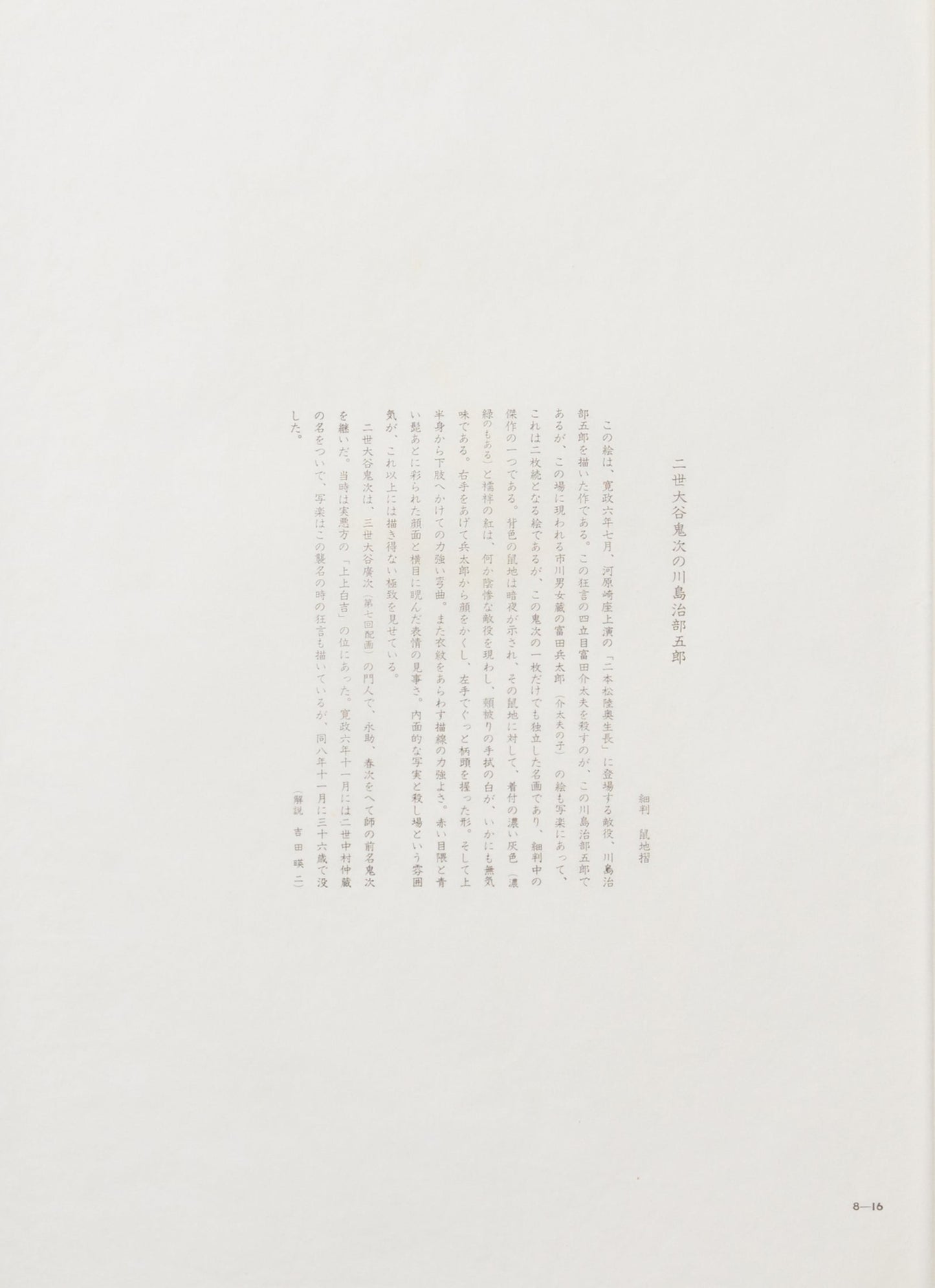
Each artwork is accompanied by a thin sheet of Japanese washi paper containing academic commentary in Japanese. For international collectors, we provide here a faithful English translation as part of the artwork’s documentation.
Artwork Description
This work depicts Ōtani Oniji II in the role of Kawashima Jibugorō from Nihonmatsu Michinoku Sodachi, performed at the Kawarazaki Theater in July 1794. The character is a principal antagonist within the drama and forms a dramatic counterpart to Tomita Heitarō, whom Sharaku portrayed in a separate print.
The dark gray background evokes a nocturnal atmosphere, intensifying the sense of danger. The muted gray tones of the outer garment, contrasted with the deep red inner lining, heighten psychological tension. The figure raises his right hand to partially conceal his face while gripping a weapon with the left, compressing movement into a charged, compact posture.
Red accents around the eyes and traces of blue facial hair sharpen the intensity of the sideways gaze. Strong linear patterns in the garment reinforce structural clarity. Through concentrated gesture, color restraint, and disciplined line work, Sharaku transforms a moment of violent confrontation into a study of contained menace.
Edition
1968 woodblock reprint
Hand printed using traditional techniques
This is a mid 20th century reprint after Sharaku’s original 1794 design.
Condition
Good impression with vibrant colors.
Details
Signature: Tōshūsai Sharaku
Date: 1968
Japanese Woodblock Print
Print size: 31 x 21 cm
Backing sheet: 41.5 x 30 cm
All artworks are sold as shown in the photographs.
About the Sharaku Series
Tōshūsai Sharaku was active for only ten months between 1794 and 1795. During this brief period, he created actor portraits that broke dramatically from convention.
Rather than idealizing his subjects, Sharaku revealed the psychological intensity of kabuki performance through bold composition and uncompromising vision.
This series presents carefully selected mid 20th century woodblock reprints, printed by hand using traditional methods, offering a renewed encounter with Sharaku’s revolutionary work.