Taxes included.
Scholarly Notes on This Ukiyo-e Print
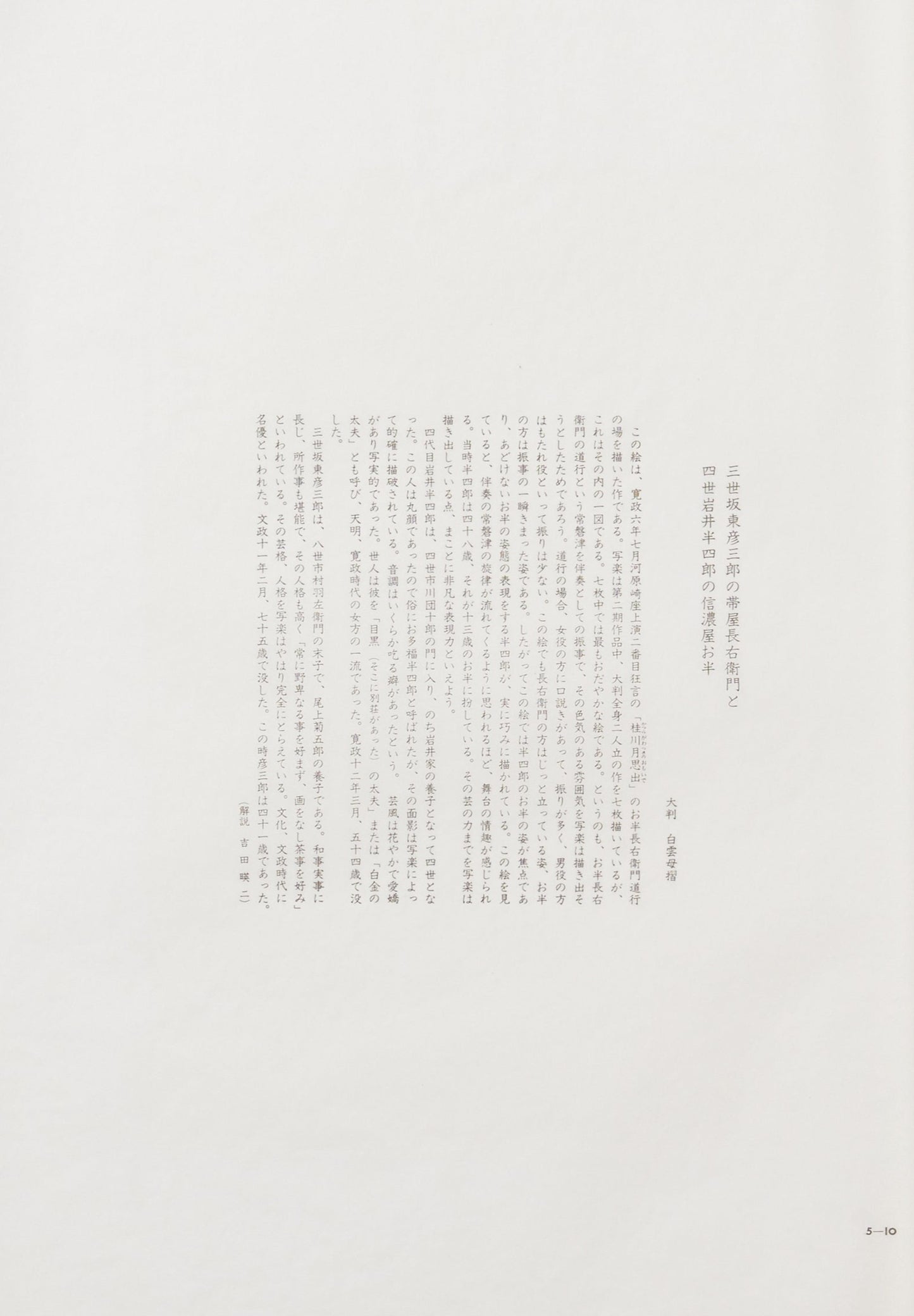
This description is based on the original scholarly notes supervised by Yoshida Eiji, a leading authority on ukiyo-e research and Sharaku studies, included with this print.
Each artwork is accompanied by a thin sheet of Japanese washi paper containing academic commentary in Japanese. For international collectors, we provide here a faithful English translation as part of the artwork’s documentation.
Artwork Description
This artwork depicts a scene from the play Katsuragawa Tsukino Omoide, performed at the Kawarazakiza Theater in July of the sixth year of Kansei (1794). It portrays Bandō Hikosaburō III as Obiya Chōemon and Iwai Hanshirō IV as Shinanoya Ohan during their journey, accompanied by Tokiwazu music.
Sharaku created seven large-format full-body portraits during his second period, and this is one of them. Among the seven, it is the most serene. The calm atmosphere likely reflects the presence of Tokiwazu accompaniment, which emphasizes dialogue and subtle movement. In this composition, Chōemon stands in stillness while Ohan is captured in motion, highlighting her youthful innocence and the expressive quality of Hanshirō IV’s performance.
Looking at this picture, one can almost sense the atmosphere of the stage, as if hearing the Tokiwazu melody. Although Hanshirō IV was forty-eight years old at the time, he portrays the thirteen-year-old Ohan with convincing delicacy. Sharaku’s ability to capture not only physical likeness but also stage presence and performance style is fully evident in this work.
Iwai Hanshirō IV entered the school of Ichikawa Danjūrō IV and later became the adopted son of the Iwai family. Known for his round face and referred to as “Otafuku Hanshirō,” he was one of the leading onnagata of the Tenmei and Kansei periods. Bandō Hikosaburō III, the youngest son of Ichimura Hazaemon VIII and adopted by Ogami Kikugorō, was admired for his refined and sincere acting style. Both actors were regarded as major figures of their era.
Edition
1968 woodblock reprint
Hand printed using traditional techniques
This is a mid 20th century reprint after Sharaku’s original 1794 design.
Condition
Good impression with vibrant colors.
Details
Signature: Toshusai Sharaku
Date: 1968
Japanese Woodblock Print
Print size: 31 x 21 cm
Backing sheet: 41.5 x 30 cm
All artworks are sold as shown in the photographs.
About the Sharaku Series
Tōshūsai Sharaku was active for only ten months between 1794 and 1795. During this brief period, he created actor portraits that broke dramatically from convention.
Rather than idealizing his subjects, Sharaku revealed the psychological intensity of kabuki performance through bold composition and uncompromising vision.
This series presents carefully selected mid 20th century woodblock reprints, printed by hand using traditional methods, offering a renewed encounter with Sharaku’s revolutionary work.