Kumano.is
Nakajima Wadaemon as Bōdara Chōzaemon Nakamura Korezō as Kanagawa-ya no Gon
Nakajima Wadaemon as Bōdara Chōzaemon Nakamura Korezō as Kanagawa-ya no Gon
Couldn't load pickup availability
Scholarly Notes on This Ukiyo-e Print
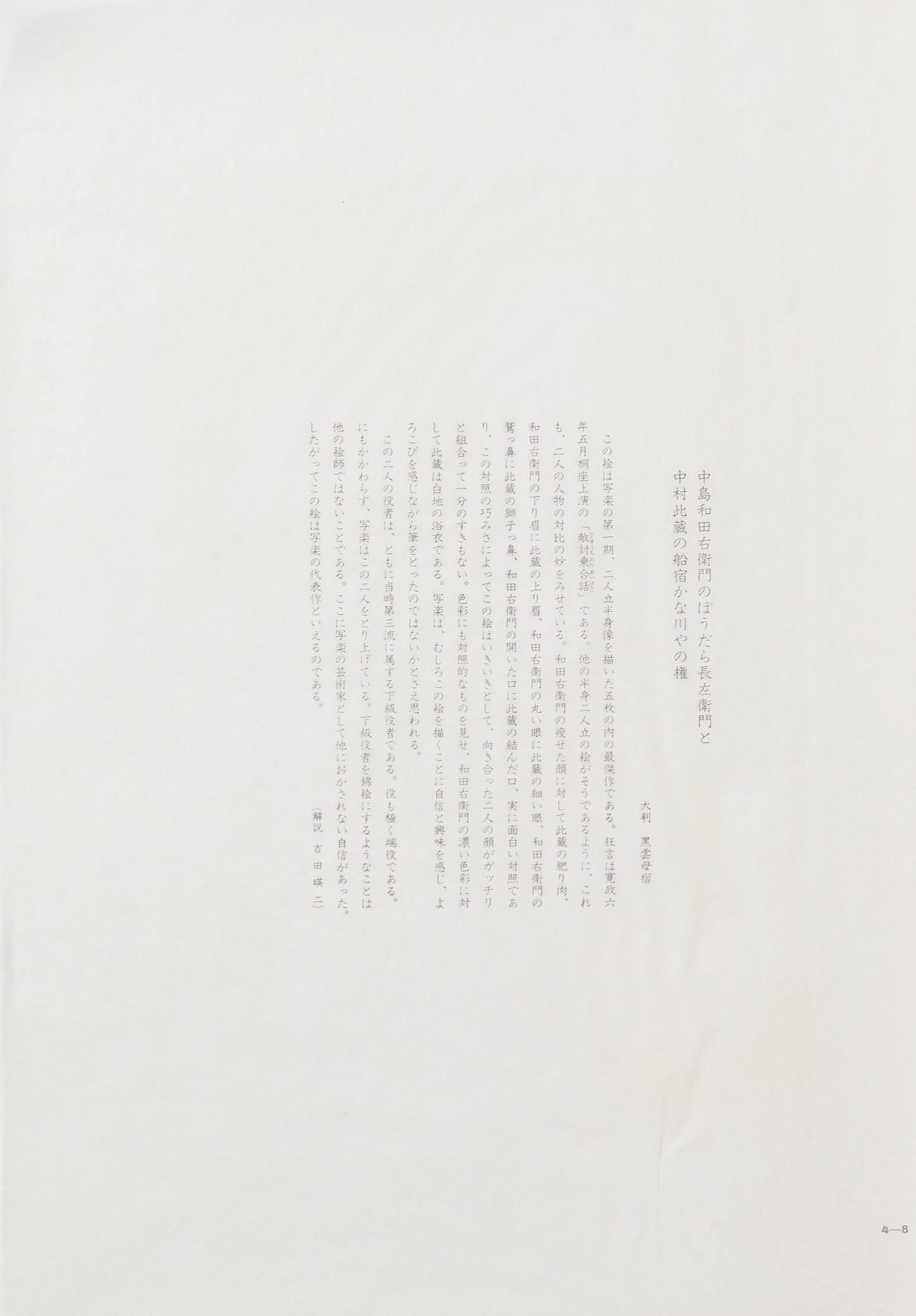
This description is based on the original scholarly notes supervised by Yoshida Eiji, a leading authority on ukiyo-e research and Sharaku studies, included with this print.
Each artwork is accompanied by a thin sheet of Japanese washi paper containing academic commentary in Japanese. For international collectors, we provide here a faithful English translation as part of the artwork’s documentation.
Artwork Description
This painting is regarded as the masterpiece among the five half-length paired portraits created by Sharaku during his first period. It depicts characters from the kabuki play Katakiuchi Noriai Banashi, performed at the Kiriza Theater in May of the sixth year of the Kansei era (1794).
As in other paired half-length portraits, Sharaku emphasizes striking contrasts between the two figures. Wadaemon’s lean face stands in opposition to Korezō’s fuller features; Wadaemon’s downward brows counter Korezō’s upward brows; round eyes contrast with narrow eyes; a hooked nose is juxtaposed with a lion-like nose; and an open mouth confronts a tightly closed one. The two faces press toward each other without leaving visual space, intensifying the dramatic tension of the composition.
The color scheme further heightens this contrast. Wadaemon’s costume is rendered in rich colors, while Korezō wears a comparatively plain white yukata. Through this deliberate opposition of form, expression, and costume, Sharaku creates a composition that is both lively and tightly constructed. The artist appears to have approached this work with confidence and perhaps even a sense of enjoyment.
At the time, both actors were classified as lower-tier performers in the third rank, and their roles were considered extreme rather than prestigious. Nevertheless, Sharaku chose to portray them. Depicting lower-ranking actors in ukiyo-e prints was uncommon among other artists, and this decision reflects Sharaku’s distinctive artistic confidence. For this reason, the painting is often regarded as one of his representative works.
Edition
1968 woodblock reprint
Hand printed using traditional techniques
This is a mid 20th century reprint after Sharaku’s original 1794 design.
Condition
Good impression with vibrant colors.
Faint soiling consistent with age.
Details
Signature: Toshusai Sharaku
Date: 1968
Japanese Woodblock Print
Print size: 31 x 21 cm
Backing sheet: 41.5 x 30 cm
All artworks are sold as shown in the photographs.
About the Sharaku Series
Tōshūsai Sharaku was active for only ten months between 1794 and 1795. During this brief period, he created actor portraits that broke dramatically from convention.
Rather than idealizing his subjects, Sharaku revealed the psychological intensity of kabuki performance through bold composition and uncompromising vision.
This series presents carefully selected mid 20th century woodblock reprints, printed by hand using traditional methods, offering a renewed encounter with Sharaku’s revolutionary work.
Share