Scholarly Notes on This Ukiyo-e Print
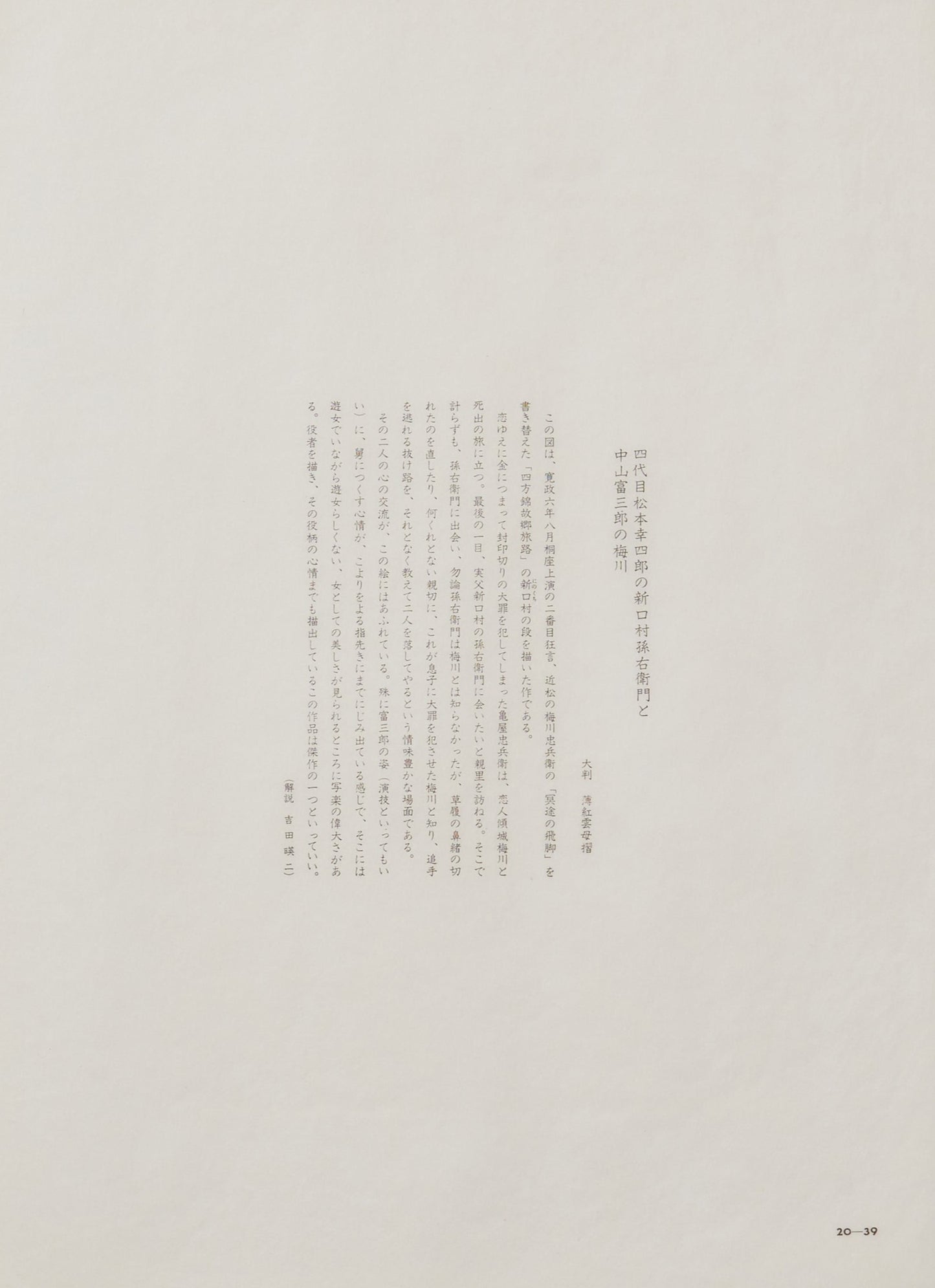
This description is based on the original scholarly notes supervised by Yoshida Eiji, a leading authority on ukiyo e research and Sharaku studies, included with this print.
Each artwork is accompanied by a thin sheet of Japanese washi paper containing academic commentary in Japanese. For international collectors, we provide here a faithful English translation as part of the artwork’s documentation.
Artwork Description
This work depicts a scene from Yomononishiki Kokyō no Tabiji, performed at the Kiriza Theater in August 1794. The play was adapted from Chikamatsu’s Meido no Hikyaku. The setting shows the village of Ninokuchimura at a moment of emotional tension and quiet recognition.
Matsumoto Kōshirō IV appears as Ninokuchimura Magoemon, the adoptive father, while Nakayama Tomisaburō portrays the courtesan Umekawa. Chūbei, driven to crime by love and debt, travels with Umekawa before their final parting. By chance, they encounter Magoemon, who does not recognize her as the woman connected to his son’s fate. In a gesture of compassion, he repairs her sandal strap and subtly guides them away from danger.
Sharaku captures the profound emotional undercurrent between the figures. The restrained gestures and expressive hands reveal inner conflict and paternal tenderness. The composition embodies Sharaku’s ability to portray both theatrical drama and psychological depth, making this work one of the most compelling examples of his artistry.
Edition
1968 woodblock reprint
Hand printed using traditional techniques
This is a mid 20th century reprint after Sharaku’s original 1794 design.
Condition
Good impression with vibrant colors.
Minor age related spots consistent with its age.
Details
Signature: Tōshūsai Sharaku
Date: 1968
Japanese Woodblock Print
Print size: 31 x 21 cm
Backing sheet: 41.5 x 30 cm
All artworks are sold as shown in the photographs.
About the Sharaku Series
Tōshūsai Sharaku was active for only ten months between 1794 and 1795. During this brief period, he created actor portraits that broke dramatically from convention.
Rather than idealizing his subjects, Sharaku revealed the psychological intensity of kabuki performance through bold composition and uncompromising vision.
This series presents carefully selected mid 20th century woodblock reprints, printed by hand using traditional methods, offering a renewed encounter with Sharaku’s revolutionary work.