Scholarly Notes on This Ukiyo-e Print
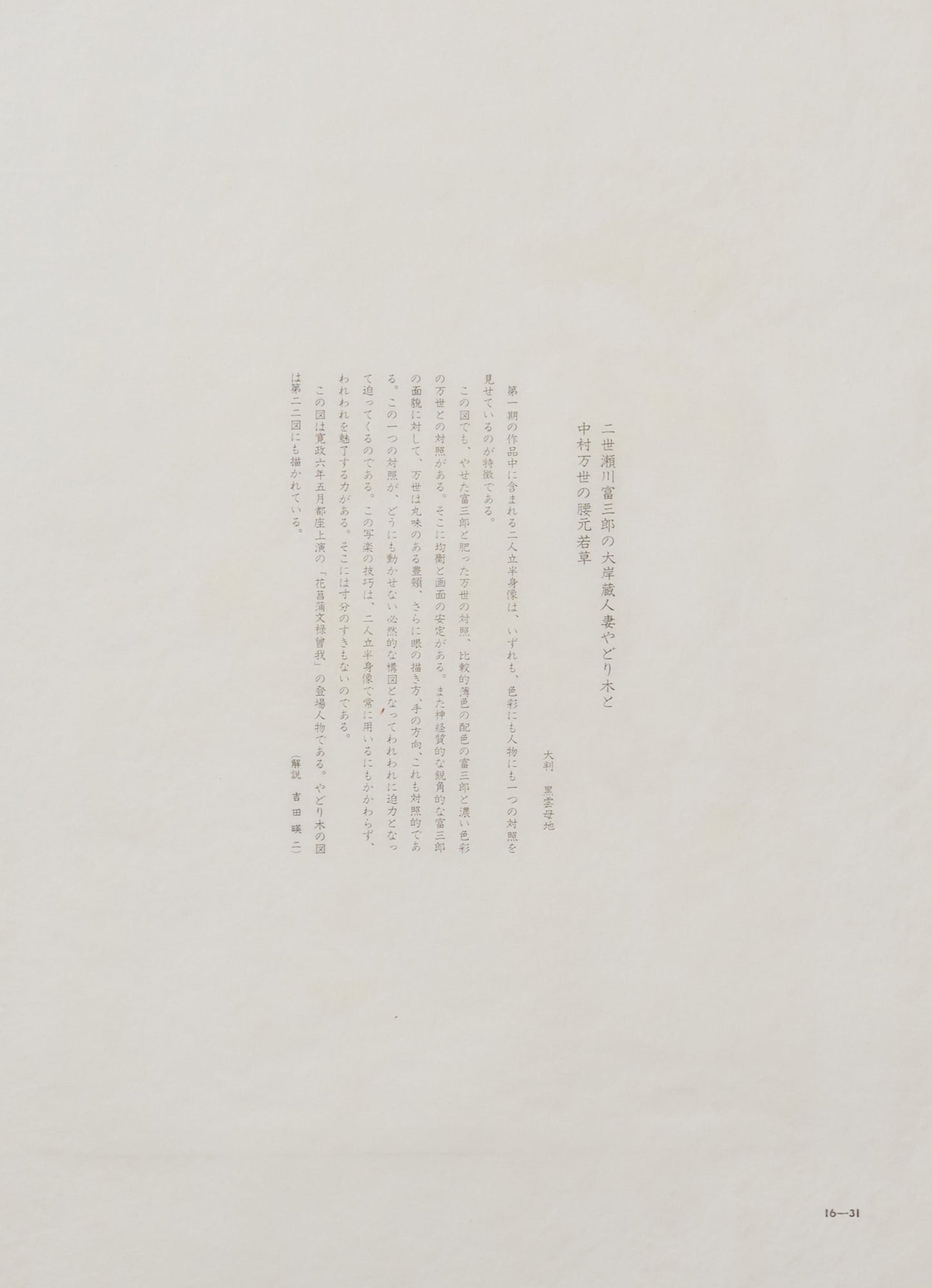
This description is based on the original scholarly notes supervised by Yoshida Eiji, a leading authority on ukiyo e research and Sharaku studies, included with this print.
Each artwork is accompanied by a thin sheet of Japanese washi paper containing academic commentary in Japanese. For international collectors, we provide here a faithful English translation as part of the artwork’s documentation.
Artwork Description
This work depicts Segawa Tomisaburō II as Yadorigi, wife of Ogishi Kurando, and Nakamura Manse as Koshimoto Wakakusa, from Hana Ayame Bunroku Soga, performed at the Toshiza Theater in May 1794. The print belongs to Sharaku’s first period and exemplifies his paired half length compositions.
A striking contrast defines the composition. Tomisaburō’s slender figure and comparatively restrained coloring stand beside Manse’s fuller form and richer palette. The interplay between light and depth of color creates visual balance and compositional stability.
Sharaku further intensifies the contrast through physiognomy and gesture. The angular tension in Tomisaburō’s features contrasts with Manse’s rounded cheeks and softer presence. Differences in eye direction and hand positioning animate the scene, demonstrating Sharaku’s mastery in orchestrating character through deliberate juxtaposition.
Edition
1968 woodblock reprint
Hand printed using traditional techniques
This is a mid 20th century reprint after Sharaku’s original 1794 design.
Condition
Good impression with vibrant colors.
Minor age related wear consistent with age.
Details
Signature: Tōshūsai Sharaku
Date: 1968
Japanese Woodblock Print
Print size: 31 x 21 cm
Backing sheet: 41.5 x 30 cm
All artworks are sold as shown in the photographs.
About the Sharaku Series
Tōshūsai Sharaku was active for only ten months between 1794 and 1795. During this brief period, he created actor portraits that broke dramatically from convention.
Rather than idealizing his subjects, Sharaku revealed the psychological intensity of kabuki performance through bold composition and uncompromising vision.
This series presents carefully selected mid 20th century woodblock reprints, printed by hand using traditional methods, offering a renewed encounter with Sharaku’s revolutionary work.