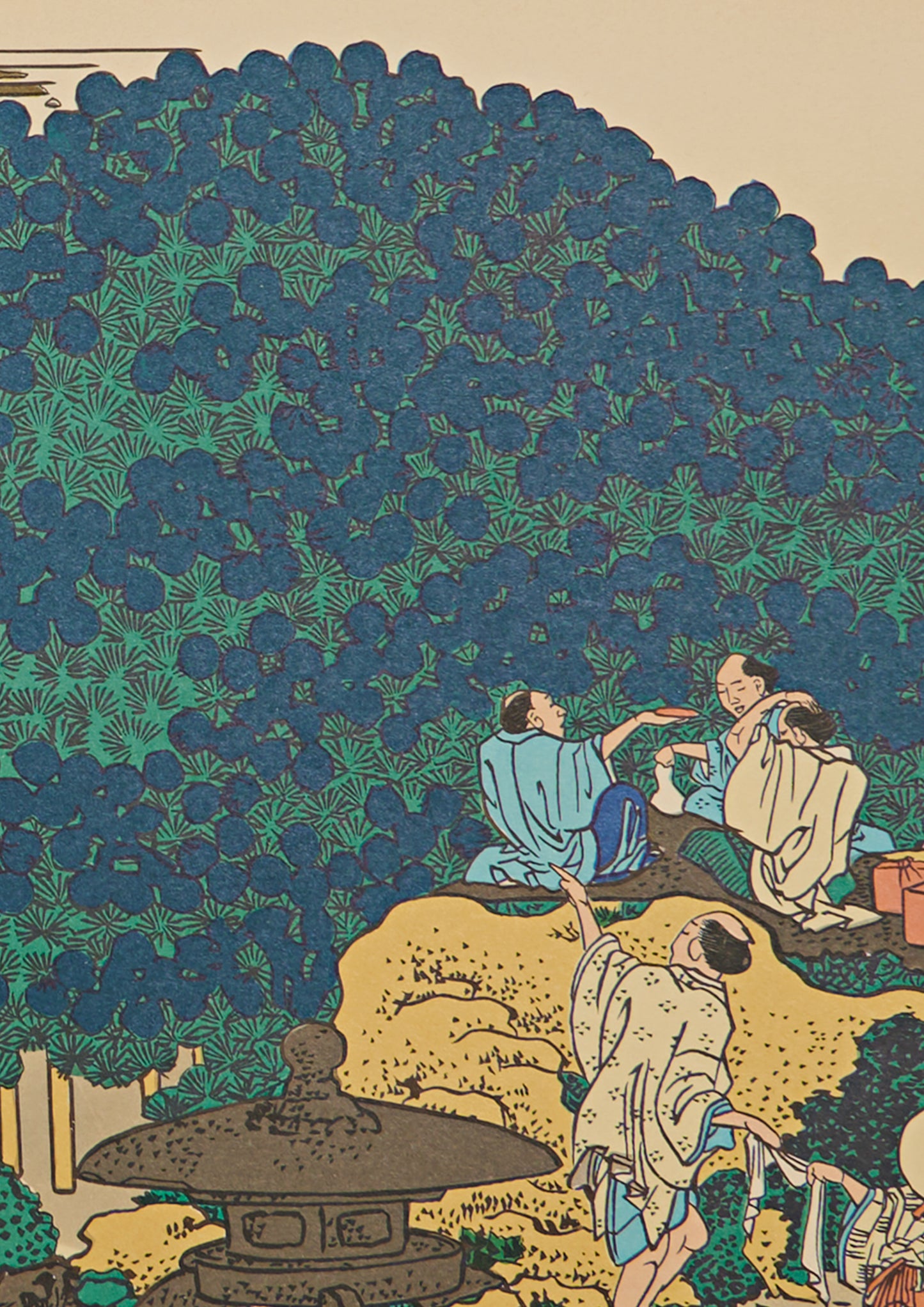
Aoyama Enza no Matsu
Thirty-six Views of Mount Fuji
Katsushika Hokusai
Artwork Description
This scene is set in the garden of Ryūgan Temple in Harajuku Village, then located on the western outskirts of Edo. The site was known for its large circular pine grove, a landmark recorded in illustrated guidebooks such as Edo Meisho Zue. The elevated ground allowed distant views toward Mount Fuji.
The composition is organized around the massive rounded canopy of the pine, which forms a dominant dome-like mass in the foreground. Its curved contour establishes the primary structural form of the image. Beneath this canopy, groups of visitors gather, sit, and move along the slope. Their gestures create localized movement within the broader static shape of the tree.
Mount Fuji appears in the distance as a sharply defined triangle. Its geometric clarity contrasts with the circular volume of the pine mound. The pairing of convex canopy and triangular peak establishes a deliberate structural dialogue across the picture plane. The foreground mass is heavy and earthbound, while Fuji remains distant and stable along the horizon.
The open sky above and the layered midground create depth without overcrowding the composition. Human activity unfolds under the shelter of the tree, yet it does not disrupt the overall balance. The pine functions as an intermediary structure between viewer and mountain.
The print clarifies a recurring structural principle within the series: natural forms are simplified into geometric relations. The circular pine mound and triangular Fuji establish equilibrium between grounded human gathering and distant geological permanence.
About Katsushika Hokusai
Katsushika Hokusai was one of the most influential ukiyo-e artists of the Edo period. Active as painter and printmaker, he expanded ukiyo-e beyond portraiture into landscapes, nature, and scenes of everyday life.
In Thirty-six Views of Mount Fuji, Hokusai transformed landscape into a structural system—juxtaposing motion and stillness, labor and faith, industry and leisure—while anchoring each composition with the enduring presence of Mount Fuji.
Reproduction
This work is a 20th century lithographic reproduction of Hokusai’s Thirty-six Views of Mount Fuji.
It is not an original Edo period woodblock print, but a later limited edition lithograph.
Hand printed and numbered 180/300 in pencil on the lower margin.
Details
Medium: Lithograph
Edition: 180/300
Size: 410 mm × 600 mm
All artworks are sold as shown in the photographs.