Taxes included.
Bushū Senju
Thirty-six Views of Mount Fuji
Katsushika Hokusai
Artwork Description
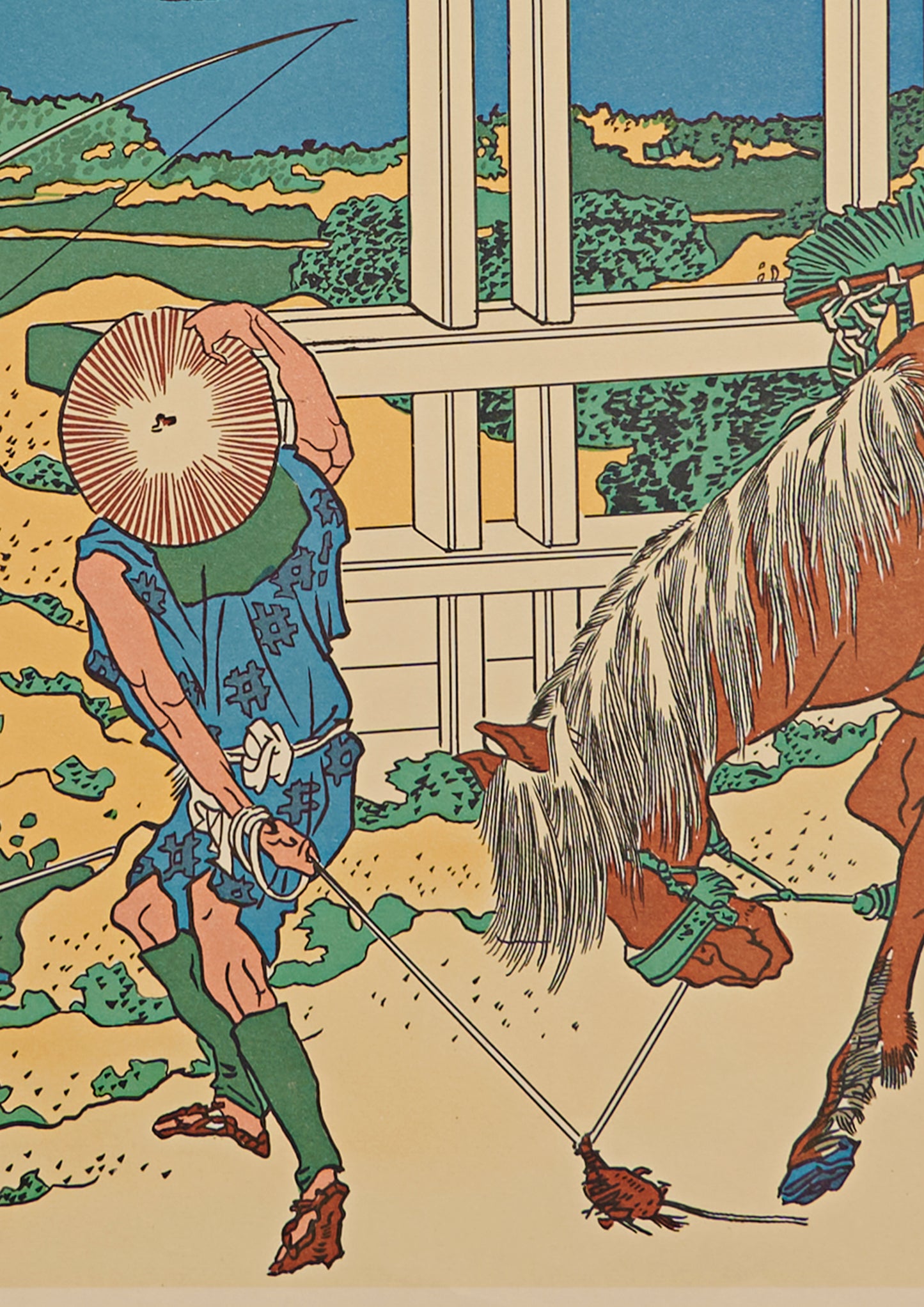
Bushū Senju forms part of Hokusai’s Thirty-six Views of Mount Fuji (c.1830–32). Senju, now in Tokyo’s Adachi Ward, was one of Edo’s four principal post towns and a major gateway toward the northern highways. Yet Hokusai avoids the busy inn district. Instead, he shifts his gaze toward the rural canals and cultivated fields that bordered the city.
A broad canal crosses the composition, corresponding to the upper Sumida River. At its center stands a water gate whose rigid vertical form slices through the horizontal landscape, establishing a geometric axis that aligns with the distant silhouette of Mount Fuji.
The composition divides into two contrasting halves.
On the right, a farmer leads a heavily burdened horse carrying bundles of Senju leeks. Their forward motion generates visual weight and density.
On the left, two fishermen sit quietly at the canal’s edge, casting lines into still water beneath open sky.
Individually, each side appears imbalanced—one compressed, the other sparse. Together, they achieve equilibrium. Density answers emptiness; movement answers stillness.
Hokusai’s brilliance lies not in anecdote but in structure. Through geometry and spatial division, he transforms an ordinary rural scene into a meditation on compositional tension. Labor, water, and distant Fuji converge within a carefully calibrated balance.
About Katsushika Hokusai
Katsushika Hokusai was one of the most influential ukiyo-e artists of the Edo period. Active as painter and printmaker, he expanded ukiyo-e from portraiture into landscape, labor, industry, and everyday life.
In Thirty-six Views of Mount Fuji, he constructs not merely scenery but a system—balancing motion and stillness, density and void, sacred mountain and human activity.
Reproduction
This work is a 20th century lithographic reproduction of Hokusai’s Thirty-six Views of Mount Fuji.
It is not an original Edo period woodblock print, but a later limited edition lithograph.
Hand printed and numbered 180/300 in pencil on the lower margin.
Details
Medium: Lithograph
Edition: 180/300
Size: 410 mm × 600 mm
All artworks are sold as shown in the photographs.