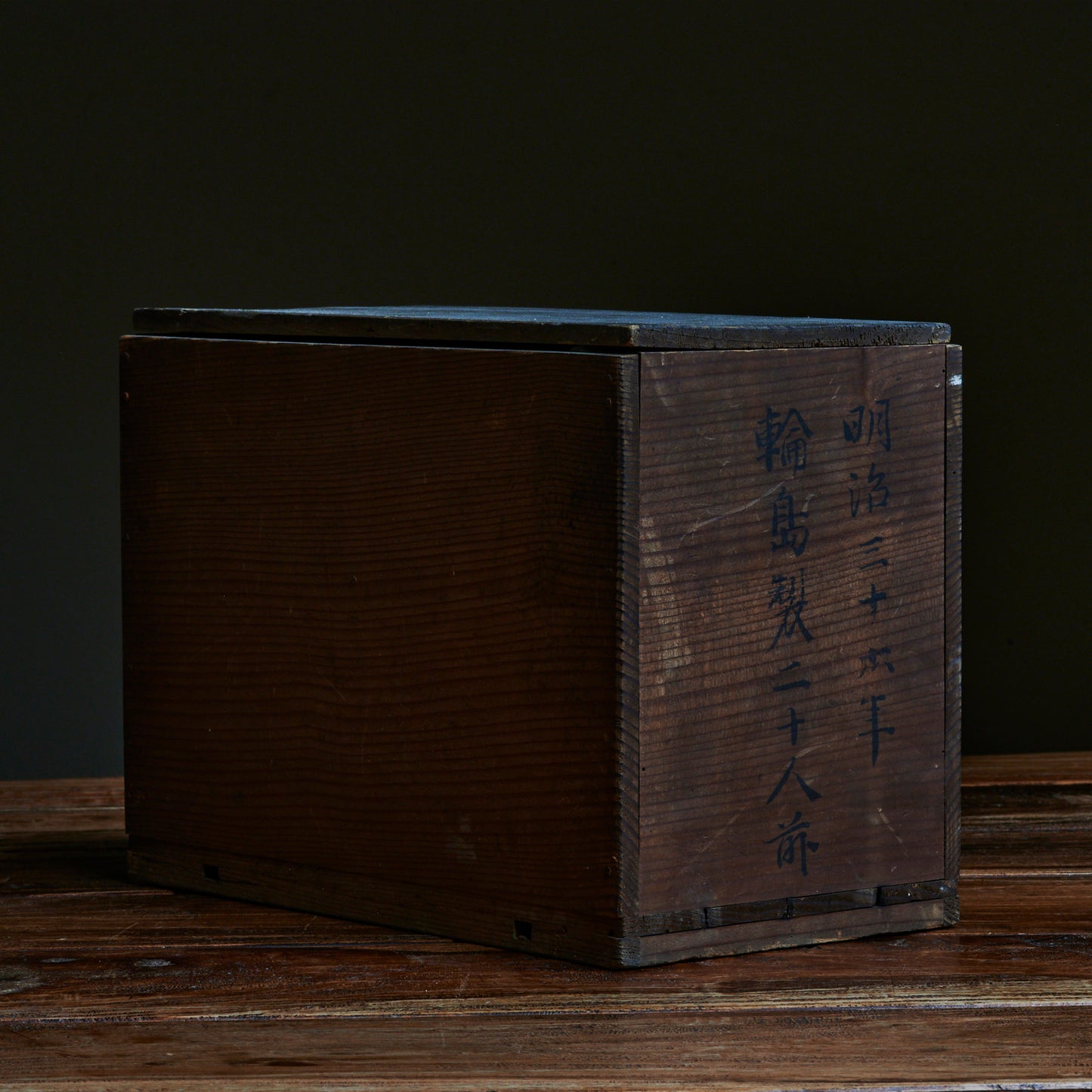
History :
The origin of Wajima lacquerware is said to either have been taught by a priest of Negoroji (a complex of Buddhist temples located in the city of Iwade, Wakayama prefecture) during the Muromachi period (1336-1573) or by a priest of Negoroji who ran away from a wartime fire set by Hideyoshi TOYOTOMI (1537-1598) during the Sengoku period (1467-1603). However, nobody knows the exact origin of Wajima lacquerware, even to this day. The common point of all the different theories is that Wajima lacquerware derived from Nego lacquerware, a lacquerware for daily use. Another possible theory is that daily-use lacquerware developed and then transformed into the current form of Wajima lacquerware. It was around 1630 during the early Edo period (1603-1868) that a form close to the present Wajima lacquerware was established. Moreover, the production process became remarkably similar to the current one between 1716 to 1736. Nowadays, Wajima lacquerware is considered to be an elegant and slightly upscale product but it actually had a different reputation before the Showa period (1926-1989). It was commonly used as a household lacquerware for important ceremonial occasions because it is solid and sturdy. However, due to changes made to the style of ceremonies and its registration as a traditional craft in 1975 by the Japanese government, it has developed more artistic connotations.