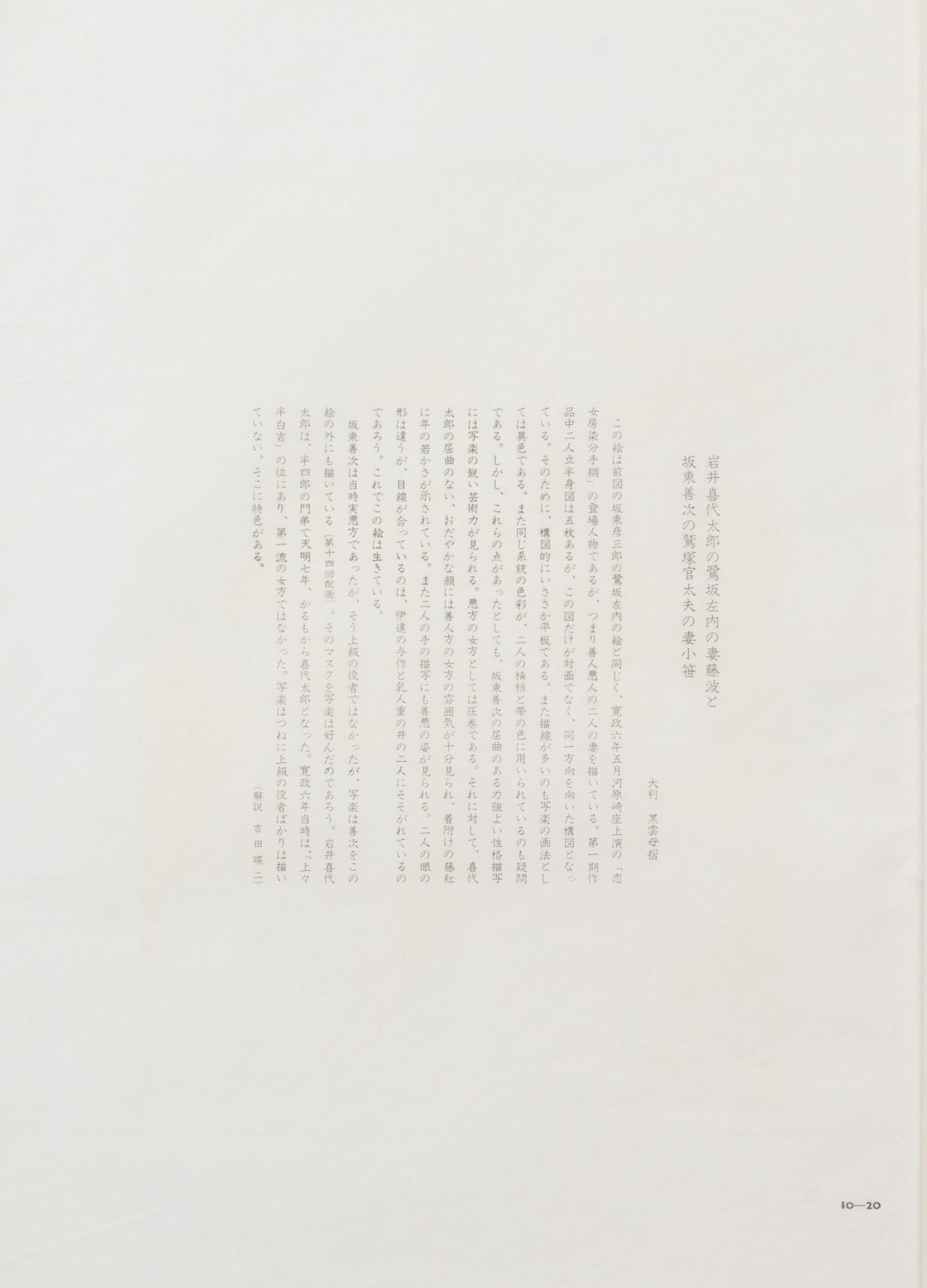
Scholarly Notes on This Ukiyo-e Print
This description is based on the original scholarly notes supervised by Yoshida Eiji, a leading authority on ukiyo e research and Sharaku studies, included with this print.
Each artwork is accompanied by a thin sheet of Japanese washi paper containing academic commentary in Japanese. For international collectors, we provide here a faithful English translation as part of the artwork’s documentation.
Artwork Description
This work depicts Iwai Kiyotarō as Fujinami, wife of Sagisaka Sanai, and Bandō Zenji as Kozasa, wife of Washizuka Kandayū, from Koi Nyōbō Somewake Tazuna, performed at the Kawarazaki Theater in May 1794. The print presents the wives of opposing characters, embodying contrasting moral qualities.
Unlike other half length portraits from Sharaku’s first period, the two figures do not confront each other directly but face the same direction, creating a distinctive compositional tension. The contrast between Fujinami’s serene expression and Kozasa’s stronger, more angular presence reveals Sharaku’s sharp psychological insight.
The subtle differences in gaze, gesture, and hand positioning suggest their connection to the unfolding drama. While Fujinami’s youthful refinement is conveyed through soft coloration, Kozasa’s bent posture and firmer expression communicate inner resolve. The work demonstrates Sharaku’s ability to differentiate character through nuanced form and expression.
Edition
1968 woodblock reprint
Hand printed using traditional techniques
This is a mid 20th century reprint after Sharaku’s original 1794 design.
Condition
Good impression with vibrant colors.
Faint soiling and a small thinned area consistent with age.
Details
Signature: Tōshūsai Sharaku
Date: 1968
Japanese Woodblock Print
Print size: 31 x 21 cm
Backing sheet: 41.5 x 30 cm
All artworks are sold as shown in the photographs.
About the Sharaku Series
Tōshūsai Sharaku was active for only ten months between 1794 and 1795. During this brief period, he created actor portraits that broke dramatically from convention.
Rather than idealizing his subjects, Sharaku revealed the psychological intensity of kabuki performance through bold composition and uncompromising vision.
This series presents carefully selected mid 20th century woodblock reprints, printed by hand using traditional methods, offering a renewed encounter with Sharaku’s revolutionary work.