Taxes included.
Noboto no ura
Thirty-six Views of Mount Fuji
Katsushika Hokusai
Artwork Description
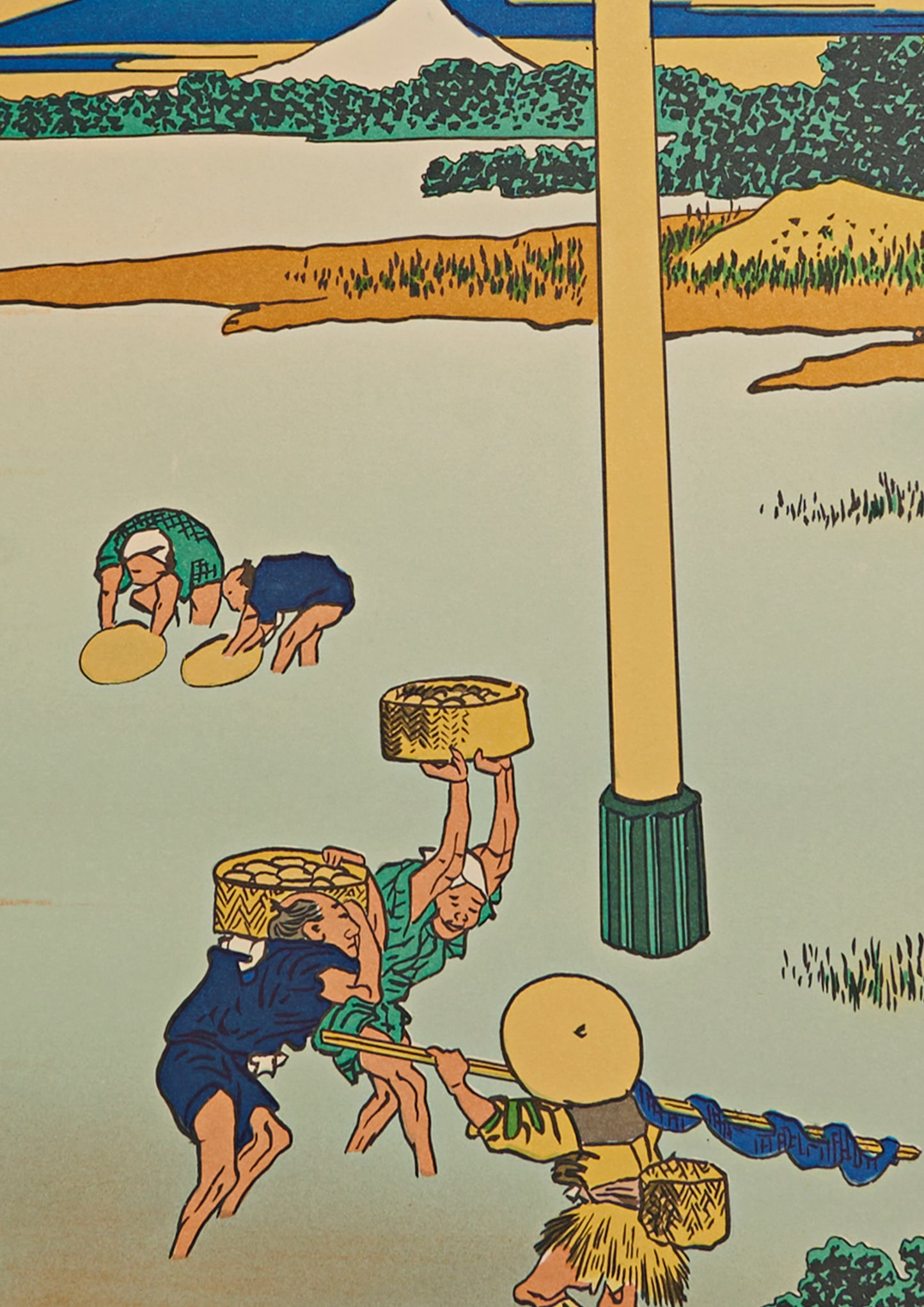
Noboto no ura portrays clam diggers at low tide along Noboto Bay, in present-day Chiba. The scene unfolds beneath the monumental torii gates of Noboto Shrine, whose vertical forms dominate the foreground.
Hokusai compresses spatial distance by placing the torii gates close together, transforming them into a visual frame through which Mount Fuji appears on the horizon. The mountain is not centrally imposed but revealed through architectural structure. Sacred space becomes a compositional device.
In contrast to the rigid geometry of the gates, figures bend, reach, and converse as they dig for shellfish. Their curved gestures and small-scale movements animate the lower half of the image. The interplay of large and small, static and dynamic, sacred and ordinary creates a carefully balanced tension.
The use of Prussian blue, recently introduced to Japan through Dutch trade, enriches the tonal depth of sky and water. The horizontal sweep of the bay and the vertical insistence of the torii generate structural clarity within the scene.
Historically, Noboto functioned as a maritime hub transporting rice and marine products from the Bōsō Peninsula to Edo. Hokusai thus situates everyday labor within both sacred geography and economic infrastructure. The mountain presides quietly over both devotion and commerce.
About Katsushika Hokusai
Katsushika Hokusai was one of the most influential ukiyo-e artists of the Edo period. Active as both painter and printmaker, he expanded ukiyo-e beyond portraits of actors and courtesans into landscapes, nature, and scenes of daily life.
His series Thirty-six Views of Mount Fuji represents a landmark in Japanese printmaking. Through bold framing devices and compositional contrasts, Hokusai transformed landscape into a space of structural invention and philosophical reflection.
Reproduction
This work is a 20th century lithographic reproduction of Hokusai’s Thirty-six Views of Mount Fuji.
It is not an original Edo period woodblock print, but a later limited edition lithograph.
Hand printed and numbered 180/300 in pencil on the lower margin.
Details
Medium: Lithograph
Edition: 180/300
Size: 410 mm × 600 mm
All artworks are sold as shown in the photographs.